
Effective treatment for Torticollis incorporates several components that work together to improve symmetry, strength, mobility, and functional movement.
A Comprehensive Treatment Plan May Include:
• Manual Therapy
• Passive and Active Range of Motion
• Strengthening Exercises
• Positioning and Handling Strategies
• Visual Tracking Exercises
• Righting Reactions and Postural Education
• Environmental Adaptations
One of the most important factors for successful treatment is early identification and early Physical Therapy intervention. If you notice signs of torticollis in your baby, speak with your Pediatrician or a Pediatric Physical Therapist.
Pediatric Physical Therapy Torticollis Treatment

Manual Therapy
Manual therapy may be used to address muscle tightness and improve mobility of the neck and surrounding structures. Your Pediatric Physical Therapist can teach you gentle techniques that are appropriate for your baby and demonstrate how and when to incorporate them safely at home.
Goals: reduce muscle tightness, improve flexibility, and increase neck range of motion.

Passive and Active Range of Motion
Range of motion exercises help address limitations in head rotation and lateral flexion. Gentle, guided movement allows your baby to explore available head and neck movement while maintaining comfort.
Your Pediatric Physical Therapist can show you how to incorporate these movements into everyday activities and play.
Goals: increase head and neck mobility, reduce movement restrictions, and encourage symmetrical movement.

Shoulder Depression
Babies with torticollis may develop compensatory shoulder elevation on one side. Gentle positioning and guided movement can help reduce shoulder elevation and promote improved alignment and neck mobility.
Goals: reduce shoulder elevation, improve cervical alignment, and decrease compensatory muscle tension.

Trunk Rotation & Guided Rolling
Guided rolling encourages symmetrical movement patterns and helps your baby learn to use both sides of the body. Using the pelvis to initiate movement, help your baby transition from supine to sidelying and from sidelying to prone on both sides.
Gentle rocking can help initiate momentum and make rolling more playful and engaging.
Goals: promote transitional movement skills, encourage symmetrical rolling, and activate both sides of the body.
Strengthening Exercises
Strengthening is an important part of torticollis treatment and focuses on the head, neck, trunk, back, and upper extremities. As your baby becomes stronger, activities should encourage active head control and symmetrical use of the body.
It is also important to watch for compensatory movement patterns. A baby may find creative ways to complete a movement while continuing to avoid using the weaker or less mobile side. Your Pediatric Physical Therapist can help identify these patterns and modify activities to promote more balanced movement.

Therapy Ball Exercises
Tummy time on a therapy ball can help develop strength and postural control while making prone play more dynamic.
Support your baby securely at the trunk while gently rocking the ball from side to side or front to back. Placing a mirror, toy, or engaging face in front of your baby can encourage head lifting, visual engagement, and active head alignment.

Incline Ramp Exercises
An incline wedge or soft ramp can make tummy time more accessible while encouraging head and neck extension, rotation, and upper-body weight bearing.
As your baby becomes more comfortable in prone, gradually adjust the activity to encourage active head movement in different directions.
Positioning and Handling Strategies
Everyday positioning is an important part of torticollis treatment. Babies spend a lot of time being held, carried, fed, and positioned for play, making these everyday moments valuable opportunities to encourage symmetry.

Prone (Tummy Time)
Tummy time is one of the most important positions for developing strength and encouraging symmetrical movement. Gradually increase the duration as your baby builds tolerance.
Mirrors, toys, or engaging faces can help motivate your baby to look in different directions and actively turn their head.
Goals: strengthen the head, neck, and upper body; encourage pushing through the arms; and promote active head rotation.

Sidelying
Sidelying can encourage your baby to turn away from the restricted direction while allowing both arms to participate in play. Positioning supports may be used when recommended by your Pediatric Physical Therapist to help maintain alignment and make play more comfortable.

Baby Carrier Positioning
When using a baby carrier, positioning your baby facing inward can provide opportunities to support developing head control while encouraging them to look toward both sides.
Your Pediatric Physical Therapist can help you determine the most appropriate positioning based on your baby’s individual needs and developmental stage.

Superman Hold
Supporting your baby in a horizontal position can encourage trunk and neck extension while providing a different way to practice head control.
This position can be performed in your arms or across your lap, with support adjusted to your baby’s developmental level and tolerance.

Visual Tracking Exercises
Encourage your baby to smoothly track toys, objects, or faces from side to side. Visual tracking activities can be practiced in a variety of developmental positions, including supine, sidelying, prone, quadruped, and supported sitting.
Using visually interesting or auditory toys can help motivate your baby to actively turn their head and engage with their environment.
Goals: encourage active head rotation, promote visual engagement, and support symmetrical head and neck movement.
Righting Reactions and Postural Education
As babies develop, they learn to adjust their head and trunk position in response to changes in their body position. These righting reactions are an important part of developing postural control and balance.

Therapy Ball Weight Shifting
Weight shifting on a therapy ball can be practiced in prone, supine, or supported sitting to challenge postural responses and encourage trunk activation.
Small, controlled shifts can encourage your baby to actively respond with their head and trunk while developing awareness of their body in space.
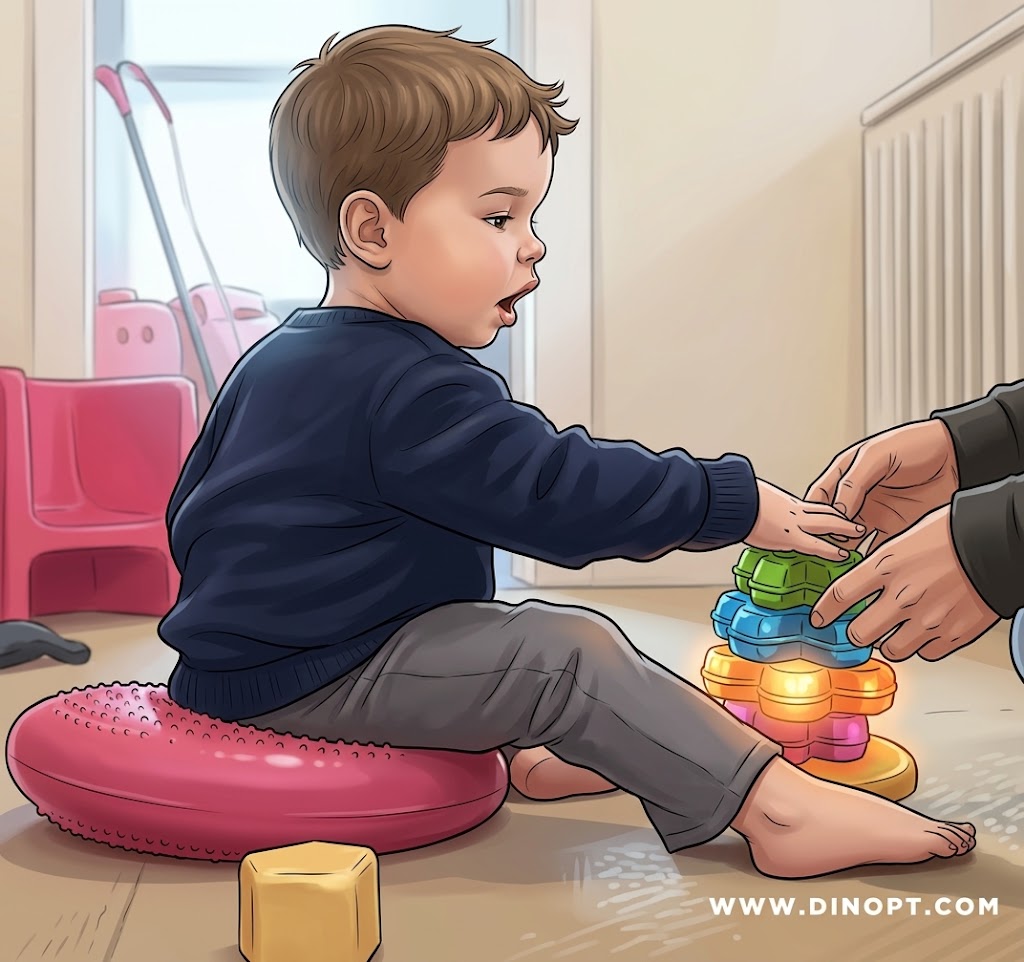
Dynamic Sitting Surfaces
As your baby develops sitting skills, dynamic surfaces such as a wedge or balance disc can provide an additional challenge to trunk stability.
These surfaces can also be incorporated into prone activities to encourage upper-body weight bearing and shoulder strength.
Environmental Adaptations
Small changes to your baby’s environment can create more opportunities for active movement throughout the day. Rather than repeatedly moving your baby’s head into a position, try arranging the environment so that interesting people, toys, and activities naturally encourage your baby to look toward the less-preferred direction.
Strategies may include:
- Positioning toys on the side opposite the preferred or restricted direction
- Placing interesting objects across the room to encourage active head turning
- Adjusting crib or changing-table orientation so that your baby has opportunities to look in different directions
- Alternating feeding positions, when comfortable and appropriate
- Using mirrors during sidelying or tummy time play
- Encouraging rolling before lifting your baby from the floor or crib
- Varying carrying and play positions throughout the day
The goal is to make symmetry part of your baby’s everyday environment. The more opportunities your baby has to actively move toward both sides during daily routines and play, the more naturally these skills can become part of their movement repertoire.
For more information check out our post Tummy Time Tips & Tricks!

Learn more about Dinosaur Physical Therapy!
To continue the conversation follow us on Facebook and Instagram
these photos are an absolutely fascinating way of showing how the body of the baby stretches here and there to help them keep limber. The top photo that shows the neck muscle is a new way to envision helping my baby keep loose and not get tightened muscles. I’m hopeful that this new way of seeing things will help me know how to keep my baby healthy and above all, comfortable. Do you have any other muscle examining photos?
Thank you for your message. The best anatomical renderings are done by Frank Netter in the “Atlas of Human Anatomy”. I highly recommend it as the most detailed comprehensive collection with a focus on functional anatomy.
Thankyou so much for this.
Thanks so much for this excellent information.
Thank you for taking the time to read this post and for your comment! Feel free to reach out directly with further questions at info@dinopt.com!