
Sitting is an exciting milestone! It gives your baby a whole new view of the world and, more importantly, a new way to play, explore, reach, and interact with the people and toys around them.
Learning to sit independently takes a combination of strength, balance, coordination, postural control, and body awareness. Here are some of the developmental steps that help babies get there, along with simple activities you can try at home.
The Building Blocks of Independent Sitting
Each child develops at their own pace, so allow your child time to gain comfort, strength, and control as they move through these stages.
Horizontal Head/Neck Control: During tummy time, your baby is able to push up on their hands and lift their head to look around.
Vertical Head/Neck Control: When held upright, your baby is able to hold their head up against gravity.
Static Support Sitting: Your baby is able to maintain a supported sitting position with assistance from a caregiver.
Dynamic Support Sitting: Your baby is able to maintain sitting while supported on a surface that provides some movement.
Independent Tripod Sitting: Your baby is able to sit while using their hands or arms to help support their body.
Independent Static Sitting: Your baby is able to maintain an upright sitting posture independently for short periods of time. Close supervision is still important for safety.
Functional Independent Sitting: Your baby is able to play and manipulate toys while sitting, including reaching to the side, across their body, and overhead without losing their balance.
Exercise & Activity Recommendations

Tummy Time on Therapy Ball

Tummy Time on Incline Ramp
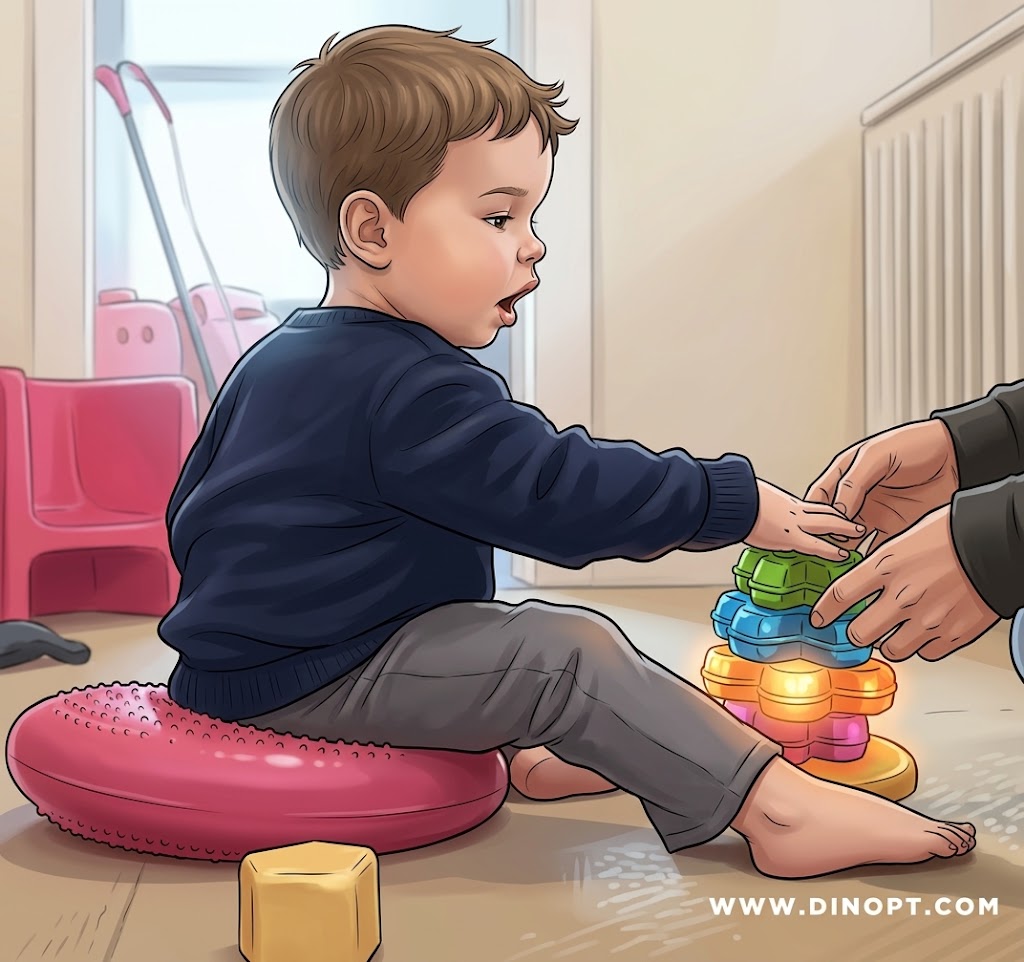
Supported Sit on Dyna-Disc

Supported Sit on Therapy Ball

Quadruped Over Foam Roller
Every baby develops at their own pace. The goal isn’t to make your baby sit before they’re ready, but to give them plenty of opportunities to build strength, practice balance, explore different positions, and move freely.
If you have concerns about your child’s development or progress toward sitting, reach out to your local Pediatric Physical Therapist!
Learn more about future Motor Milestones here!

Learn more about Dinosaur Physical Therapy!
To continue the conversation follow us on Facebook and Twitter
Very informative thanks
Thank you for your comment! So glad it was helpful!
My son is almost 18months. I have no concerns about his physical development except that he does not sit in tall kneeling. He hates it. Is this something I should be working on?
Hi Jillian! Thank you for your question! Tall kneeling is a really nice developmental position as it allows development of trunk strength/stability while promoting weight bearing through knees. It is not a necessary position, but a great “developmental option”. Have you tried finding different surface heights to facilitate kneeling at? My son loved the cube chair, we also stack couch cushions and place his books atop them to encourage kneeling while engaged in reading and flipping the pages!
I’ve tried a few things, but he’ll usually just stand up even if it means he needs to bend over a bit. Seems he really just does not like it. Maybe it bothers his knees
Great post! Thank you for this information! My son is turning 6 months this week and falls over from a sitting position after a few seconds without a prop or person to hold him up. He has done a good amount of tummy time since birth and I have been working on transitioning into sitting a little.
My question is how is his floor time best spent (what percentage of time spent on on tummy time versus supported sitting versus other exercises)? I have read that persistent tummy time at this age lends itself to the child independently transitioning into sitting when ready. Have you found that to be the case, or is supported sitting important at this age and to what degree? Thanks so much for your insight!
Hi Jessica! Great question! Tummy Time continues to be important as children begin to transition to quadruped (on all fours) and begin creeping and eventually crawling forward. In terms of mobility you can encourage forward movement by putting motivating objects just slightly out of reach. You can also help facilitate motor planning the transition to sitting and then spend some time weight shifting to address trunk strength/balance reactions. Then allowing the transition from sitting back onto belly. Transitional movements are a big focus at this stage. Sounds like your son is right on track from a gross motor development perspective! Feel free to reach out with any additional questions via email at info@dinopt.com! More than happy to be a resource for you!