 Common questions that parents often ask therapists are: “When should my child crawl or walk up the stairs?” and “How can I help my child safely walk up and down the stairs?”
Stair climbing may sound nerve-racking, but it is actually a great way to develop strength, balance, coordination, and motor planning while helping children become more confident and safe on stairs.
- Make sure you have safety gates on your stairs, especially when teaching your child the correct way of walking up and down the stairs.
- Initially, start practicing a few steps at a time before tackling the entire staircase.
- It is easier to learn how to walk up the stairs than down.
- Once your child has mastered walking up three to four steps, you can then practice on a full set of stairs.
- Be sure to stand behind your child when they are walking up the stairs for optimal safety. When walking down the stairs, stand below and slightly to the side of your child.
Stair Climbing Milestones
 Around 1 year: Children may begin to crawl up the stairs with supervision and assistance as needed.
 Around 2 years: Toddlers may begin walking up and down stairs using a step to (non-alternating) pattern, often with hand held or rail assistance.
 Around 3 years: Children may begin walking up stairs using an alternating stepping pattern without the handrail, while continuing to use a step-to pattern when walking down.
 Around 4 years: Children may begin walking up and down stairs using an alternating stepping pattern without support.
Keep in mind that these are general developmental ranges, not strict age-based expectations. Every child develops at their own pace, and stair climbing skills may emerge earlier or later depending on their strength, balance, coordination, confidence, and experience.
Tips & Tricks to Encourage Stair Climbing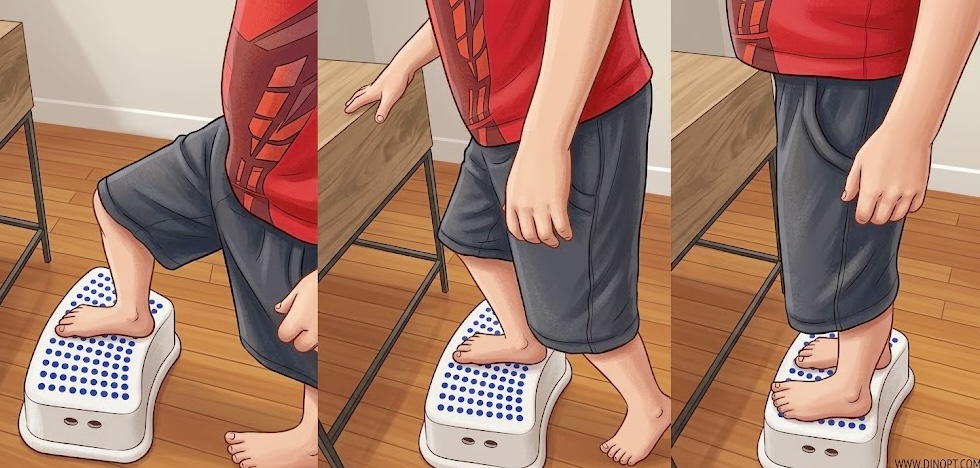 Step Stool: Place a step stool against elevated surface. Have child step up onto the step stool to reach for toys placed on top of the surface. Then have them turn around and step down with hand held assistance as needed.
 Sit to Stand: Place the step stool in front of elevated surface and have your child stand up to retrieve a toy. Encourage child to push through legs without upper body support to target lower body and trunk musculature.
 Bicycle Kicks: This is a fun exercise which helps to strengthen the leg muscles, abdominal muscles, and improve body awareness. As the child lies on back, hold ankles and passively move legs forward and back, as if they are pedaling a bicycle. Sing a song as you pedal to keep child engaged & entertained!
 Single Leg Balance: When a child walks up or down the stairs, they have to be able to balance on one leg in order to bring the opposite leg to the next step. While your child is playing with toys placed on elevated surface, sit right behind them and lift up one leg off the floor for 10 seconds, repeat on other leg.
 To challenge your child, you can have them stand on a balance disc or pillow and perform the same leg lift.

Stair Negotiation: Place stickers or tactile footprints on stairs to help child develop reciprocal motor pattern. Verbal cues such as “one, two” or “step and step” can help promote alternating feet when negotiating the stairs.

As your child becomes more confident, practice stepping up and down curbs and navigating stairs in different community settings, such as playgrounds, libraries, shopping centers, and friends’ houses. This helps children generalize their stair climbing skills across different environments.
Sensory Strategies: Incorporating different types of sensory input can help reinforce stair climbing patterns through multimodal learning.
- Tactile: Use tactile elements on each step, such as tactile footprints, felt cutouts, fine grain sand paper. Practice barefoot to reinforce foot placement.
- Auditory: Use auditory cues to establish cadence through clapping, an egg shaker, or a song.
- Proprioceptive: Ask child to stomp their feet to provide deep input and promote full weight bearing
- Visual: Strips of brightly colored tape can help encourage alternating feet.
The goal is to make stair practice fun, functional, and safe while giving your child opportunities to build strength, balance, coordination, and confidence along the way!
Learn more about Dinosaur Physical Therapy!
To continue the conversation follow us on Facebook and Instagram
I love the visual ideas for stair climbing! Thanks for sharing this great post.
Thank you for this post. Am I able to share individual pictures with a parent if I leave in your website that is noted on the picture?
Happy for you to share with credit given to the origin of photos. Best wishes!
Thank you so much for the ideas!! COTA Peds here!
Thank you for your support!